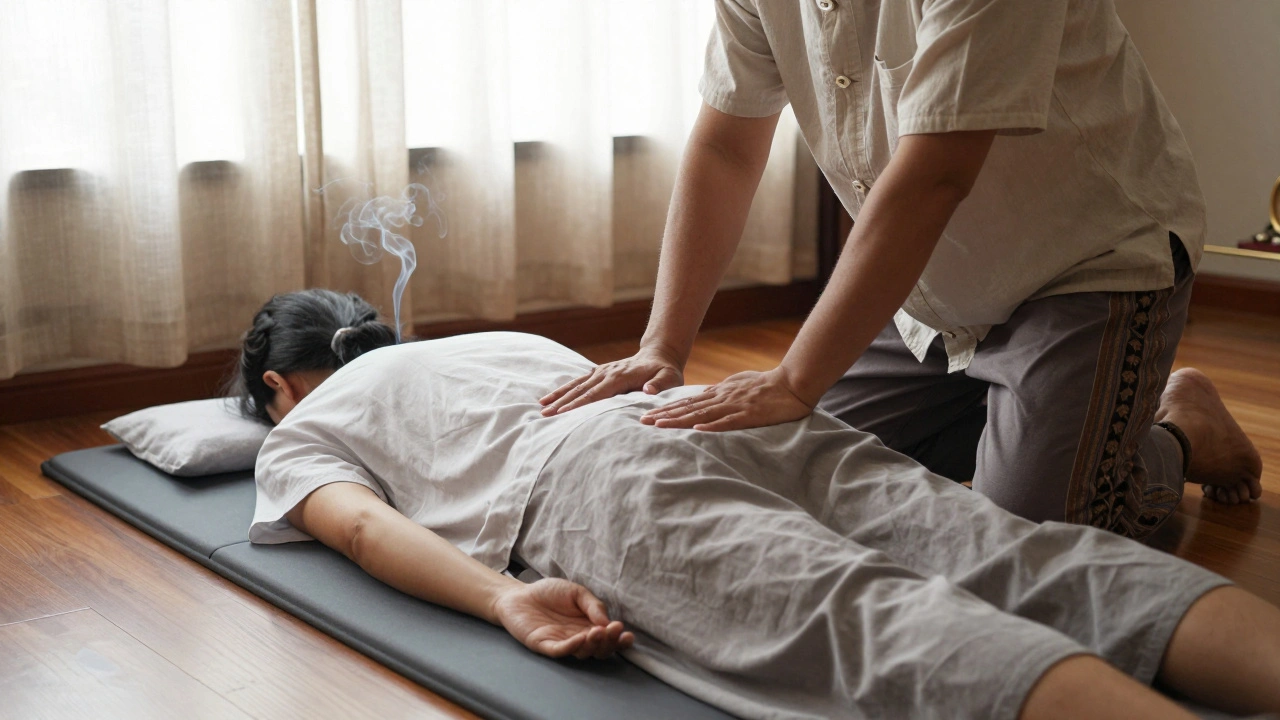
You’ve probably seen it in movies: a therapist using their hands, feet, elbows, and even knees to stretch and press a person lying on a mat, all while the client looks completely relaxed. That’s Thai massage - and it’s not just another spa treatment. It’s a 2,500-year-old healing system that blends acupressure, assisted yoga, and energy line work. If you’ve ever walked out of a session feeling like you’ve been gently reset, you know why it’s become one of the most sought-after therapies in places like Istanbul, where people crave deep relief from stress and stiffness.
What Is Thai Massage, Really?
Thai massage, or Nuad Boran (which means "ancient massage" in Thai), isn’t about oil, candles, or soft music. It’s done fully clothed, usually on a padded mat on the floor. The therapist moves you through a series of stretches and rhythmic compressions - like a guided yoga session where someone else does the work. You don’t have to be flexible. You don’t even have to be awake. It’s common for people to drift off during the session.
Unlike Swedish massage, which focuses on muscles, Thai massage works on energy lines called sen lines. Think of them like rivers of life force flowing through your body. When they’re blocked - from sitting too long, stress, or injury - you feel tight, tired, or achy. Thai massage clears those blocks. It’s not just relaxation; it’s restoration.
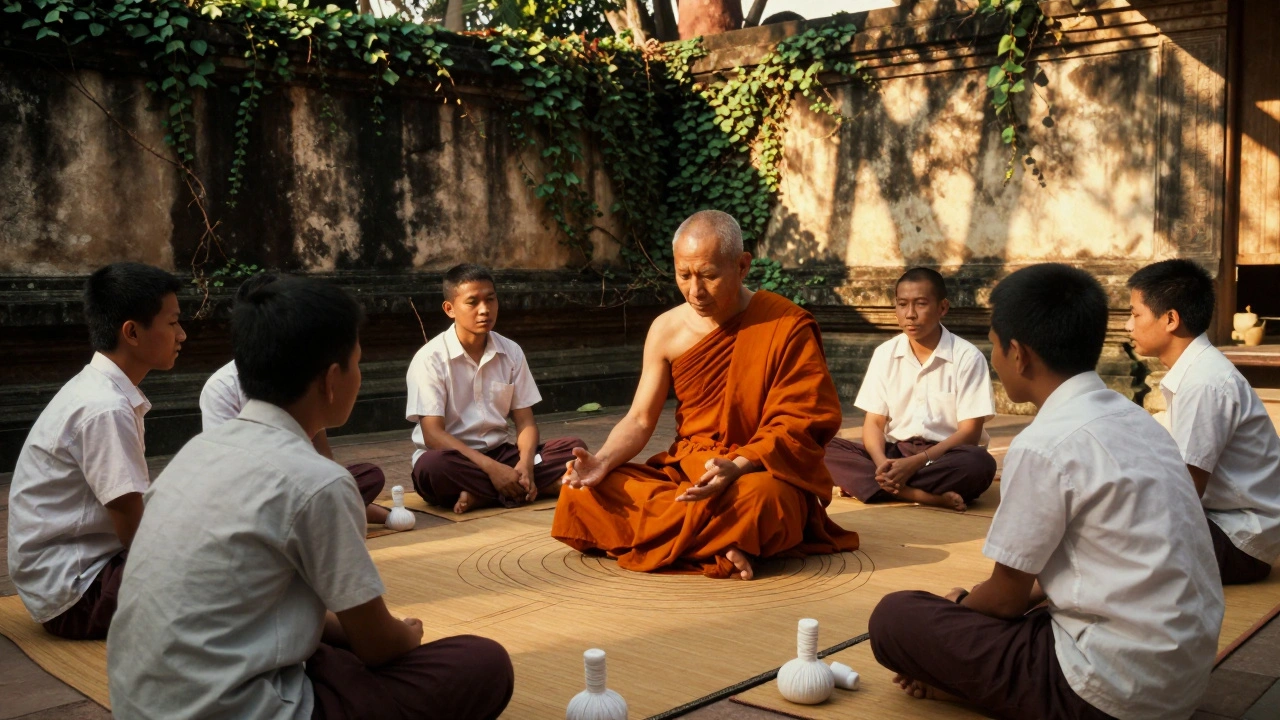
It’s not just a technique. It’s a tradition passed down from master to student, often rooted in Buddhist monasteries. The first Thai massage schools were founded by Buddhist monks who combined Indian Ayurvedic medicine with local healing practices. Today, it’s recognized by UNESCO as an Intangible Cultural Heritage.
Why Thai Massage Works: The Real Benefits
Let’s cut through the hype. What does Thai massage actually do for your body?
- Breaks chronic tension - If your shoulders feel like they’re holding up the world, Thai massage releases those knots better than any foam roller. The deep pressure and passive stretching retrain your muscles to relax.
- Improves flexibility - You don’t need to be a yogi. After just a few sessions, many people notice they can bend over to tie their shoes without groaning.
- Reduces stress and anxiety - One 2023 study in the Journal of Alternative and Complementary Medicine found that participants who received Thai massage weekly for four weeks showed a 38% drop in cortisol levels. That’s the body’s main stress hormone.
- Boosts circulation - The rhythmic pressing and stretching pushes blood through tight areas, helping oxygen and nutrients reach tired tissues.
- Helps with back and neck pain - A 2022 trial in Thailand showed Thai massage was as effective as ibuprofen for chronic lower back pain - without the side effects.
People in Istanbul who work long hours at desks, commute in heavy traffic, or carry kids and groceries all day swear by it. One teacher I know started going twice a month after her sciatica flared up. Within six weeks, she was walking without pain. "It’s like my body remembered how to move," she told me.
How Thai Massage Is Done: The Techniques Behind the Magic
It’s not just about pressure. It’s about rhythm, timing, and intention.
Therapists use their whole body - thumbs, palms, elbows, knees, even feet - to apply pressure along the sen lines. There are 10 main lines, but the most commonly worked are:
- Sen Sib - runs from the crown of the head down the spine to the tailbone. This one’s key for stress and sleep.
- Sen Ittha - flows from the nose to the third eye, then down the neck and arms. Used for headaches and sinus pressure.
- Sen Kalathari - circles the body like a belt. Helps with digestion and lower back tension.
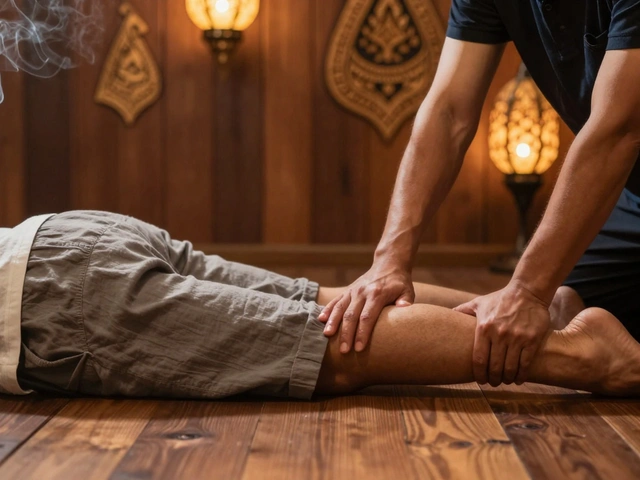
The session usually starts at the feet and moves upward. You’ll be rocked, pulled, twisted gently, and pressed. Some moves feel intense - like a deep stretch you’d never dare do on your own. Others feel like warm waves rolling over you.
There’s no massage oil. No music. Just breath. The therapist will often breathe in sync with you. That’s intentional. It’s part of the mindfulness. You’re not just being massaged - you’re being guided into presence.
Thai Massage in Istanbul: Where to Find Authentic Sessions
Thai massage isn’t new to Istanbul. For over a decade, Thai therapists have been setting up shops in neighborhoods like Kadıköy, Beşiktaş, and Nişantaşı. But not all "Thai" massages are created equal.
Look for places that say "Traditional Thai Massage" or "Nuad Boran" - not "Thai-style" or "Thai-inspired." Authentic sessions are done on the floor, not on a table. The therapist should wear loose clothing, not a bikini. And they should use their body weight, not just their hands.
Some well-known spots in Istanbul:
- Thai House Istanbul (Kadıköy) - Run by a Thai family who trained in Chiang Mai. Sessions start at 150 TL for 60 minutes.
- Wat Pho Wellness (Beşiktaş) - Founded by a former monk. Offers 90-minute full-body sessions with herbal compresses.
- Samui Thai Spa (Nişantaşı) - More upscale, but still follows traditional techniques. Great for first-timers.
Ask if the therapist trained in Thailand. Many local therapists have taken weekend courses. Real mastery takes years.
What to Expect During Your First Session
Walk in wearing loose, comfortable clothes - sweatpants and a T-shirt work fine. No need to bring anything. You’ll be asked to remove shoes and jewelry.
You’ll lie on a mat. The therapist will begin by checking in: "Do you have any injuries? Any areas you want extra focus on?" Then they’ll start - slowly, gently. You might feel a stretch that makes you gasp. That’s normal. But if it hurts, say so. Good therapists adjust on the fly.
Some people cry. Others laugh. Some fall asleep. All are normal. There’s no "right" way to react. The goal isn’t to feel good the whole time - it’s to feel released afterward.
Afterward, you’ll be offered warm herbal tea. Don’t rush out. Sit quietly for 10 minutes. Your body is still integrating the work. Drink water. Avoid caffeine or heavy meals for the next few hours.
Thai Massage vs. Swedish Massage: What’s the Difference?
| Aspect | Thai Massage | Swedish Massage |
|---|---|---|
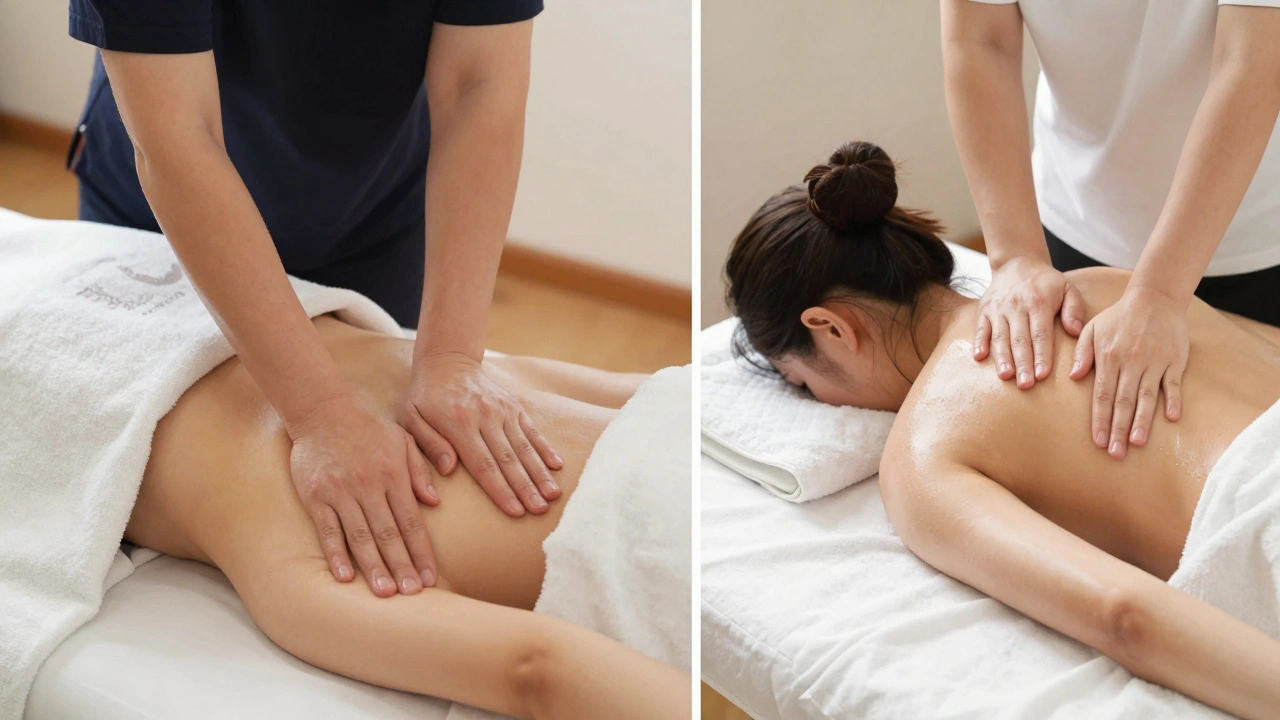
| Setting | Floor mat, fully clothed | Massage table, unclothed (under towel) |
| Technique | Stretching, compression, energy lines | Gliding strokes, kneading, light pressure |
| Focus | Energy flow, flexibility, alignment | Relaxation, muscle tension |
| Oil Used | No | Yes |
| Duration | 60-120 minutes | 60-90 minutes |
| Best For | Chronic stiffness, poor posture, low energy | Stress relief, light tension, pampering |
Swedish massage is like a warm hug. Thai massage is like a full-body tune-up. One soothes. The other transforms.
Who Should Avoid Thai Massage?
It’s safe for most people - but not everyone.
Avoid it if you have:
- Recent fractures or bone injuries
- Severe osteoporosis
- Deep vein thrombosis (blood clots)
- Open wounds or infections
- Advanced pregnancy (unless cleared by your OB-GYN)
If you’re on blood thinners, let your therapist know. The pressure might cause bruising. If you’re new to bodywork, start with a 60-minute session. Don’t jump into a 90-minute deep work unless you’re ready.
Frequently Asked Questions
Is Thai massage painful?
It can be intense, but it shouldn’t hurt. Good Thai massage feels like a deep, satisfying stretch - the kind where you say, "Oof, that’s the one I needed." If you’re wincing or holding your breath, speak up. The therapist can ease off. Pain isn’t progress here.
How often should I get Thai massage?
For maintenance, once a month is enough. If you’re dealing with chronic pain, stiffness, or high stress, twice a month for 2-3 months helps reset your body. After that, you can taper off. Think of it like exercise - consistency matters more than intensity.
Can I do Thai massage at home?
You can try simple stretches, like pulling your knee to your chest or doing gentle twists. But the real magic of Thai massage comes from the therapist using their body weight and precise technique. You can’t replicate that alone. Think of it like yoga - you can do poses yourself, but a teacher makes the difference.
Does Thai massage help with migraines?
Yes - especially when focused on the head, neck, and shoulders. Many people report fewer headaches after regular sessions. The therapist works on Sen Ittha, which runs from the nose to the third eye, releasing tension that often triggers migraines.
How long does a Thai massage session last?
Most sessions are 60, 90, or 120 minutes. For first-timers, 60 minutes is ideal. That’s enough to feel the effect without being overwhelmed. Longer sessions allow deeper work on the legs, back, and hips - great if you’re very tight.
Ready to Feel Lighter?
Thai massage isn’t a luxury. It’s a reset button for tired bodies and stressed minds. Whether you’re sitting at a desk all day, caring for kids, or just feeling like your body forgot how to move - this is your invitation to try something different. No magic. No gimmicks. Just ancient wisdom, hands-on care, and a quiet moment to breathe.
Book your first session this week. Wear loose clothes. Bring an open mind. And let your body remember what it feels like to be truly relaxed.
So let me get this right-you’re telling me I can pay someone to stretch me like a pretzel… and it’s considered "ancient wisdom"?? 😅 I’ve had Thai massage twice, and both times I thought I was being attacked by a very polite yoga instructor. But… I also didn’t cry? So… point? I guess it works??
You call it "ancient wisdom," but it’s just applied biomechanics wrapped in spiritual branding. The sen lines? They’re not energy channels-they’re fascial planes. The monks didn’t know about connective tissue, they just noticed that pressing certain spots made people feel better. The real magic? Human touch. Not mysticism. Stop romanticizing what’s just physics with a cultural veneer.
LET ME TELL YOU SOMETHING-THIS ISN’T A MASSAGE, IT’S A PSYCHOSOMATIC REBIRTH CEREMONY. I went in thinking I’d get a stretch. I came out sobbing in the parking lot because my soul remembered I had a spine. The therapist didn’t just move my body-she unraveled 17 years of corporate trauma, bad relationships, and that one time I said "I’m fine" to my therapist. I now have a shrine to my Thai massage therapist in my living room. She’s my spiritual midwife. If you haven’t cried during a kneecap twist, you haven’t lived. 🌊🪔
It is both fascinating and profoundly humane that a practice rooted in monastic tradition, blending Ayurvedic principles with indigenous Thai healing, has endured for millennia and continues to offer tangible physiological and psychological benefits in an increasingly mechanized world. The absence of oil and the emphasis on mindful, whole-body engagement reflect a holistic understanding of health that modern medicine often overlooks. One cannot help but admire the discipline and intentionality inherent in this art.
Ugh. I’ve seen this post before. And yes, it’s cute that you think Thai massage is "transformative"-but have you considered that 38% cortisol drop? Probably just placebo + the fact that you were lying still for an hour without checking your phone. Also, "sen lines"? That’s just acupuncture with extra steps. I’ve had a better stress release from a 20-minute nap in my car. 🤷♀️
I love how you included the specific sen lines-Sen Sib, Sen Ittha, Sen Kalathari-I actually printed this out and showed my therapist, and she got so emotional she gave me an extra 10 minutes for free! 😭 She said no one’s ever asked about the lines before. I’ve been going for six months now, and I swear I can feel the energy flowing. I even started meditating after sessions. It’s not just massage-it’s a ritual. Thank you for writing this with such care. 🙏
What’s fascinating is the neurophysiological resonance between Thai massage’s rhythmic compression and vagal tone modulation. The proprioceptive input from passive stretching + synchronized breathing triggers parasympathetic dominance-hence the cortisol drop. It’s not mysticism; it’s embodied neurology. Also, the cultural framing as "energy lines" is a brilliant heuristic for laypeople to conceptualize fascial release. The real innovation? The therapist’s body as a biomechanical instrument. No tools. Just leverage, gravity, and intention. 🌿🧠
Okay, but what if this is all a distraction? Who funds these Thai massage schools? Who trained the monks originally? Did you know that the Thai government started promoting this in the 90s to attract Western tourists? The UNESCO designation? That’s PR. The real reason you feel better? Because you’re being held-physically and emotionally-by someone who’s trained to read your tension like a book. But who taught them to read it? And why is it only in certain neighborhoods in Istanbul? Coincidence? Or is someone controlling the narrative? I’ve seen the same patterns in Reiki and crystal healing. It’s all just rebranded trauma therapy with a cultural filter. Don’t be fooled.
I appreciate the depth of this article, and I believe it provides a thoughtful, well-researched overview of Thai massage. However, I would respectfully suggest including a brief note about ethical considerations-for example, ensuring therapists are fairly compensated and that cultural appropriation is avoided when such practices are commercialized abroad. The tradition deserves reverence, not just tourism. Thank you for honoring its origins.